In this article
Quick answer: In Procore, retainage is released on the subcontractor invoice: the GC’s invoice administrator enters an amount in the Total Retainage Released column for each line, or raises a release-of-retainage invoice. That changes the invoice; it does not pay anyone. The sub still has to get the release entered, supply the waiver, chase the payment by the state deadline and pass its own sub-tiers’ share down.
Every Procore fact below comes from Procore’s own support pages, fetched 2026-10-13. Procore can label tools differently for owners and specialty contractors; this guide uses the default general contractor terms.
How Procore holds retainage
Retainage in Procore lives on the commitment and is withheld line by line. Procore defines it as the part of a contract withheld until the work is deemed satisfactorily complete, and says 5 to 10% is common.
- Retainage is enabled on the subcontract or purchase order. The invoice type has to include retainage.
- Each invoice withholds per line. Enter a dollar amount and Procore calculates the percentage, or the reverse. Procore’s example: $1,250 withheld on a line calculates as 5%.
- The Total Retainage column keeps the running total withheld on each line across invoices.
- Sliding scale retention is supported for contracts that step the rate down, for example 10% of each invoice until 5% of the subcontract is held.
How retainage is released
The release is entered on the invoice, line by line. Per Procore’s article on setting or releasing retainage on a subcontractor invoice:
- Open the project’s Commitments tool and the commitment.
- On the Invoicing tab, open the draft invoice, or create a new one for the release.
- Scroll to the Schedule of Values and the retainage columns.
- Enter the amount to release in Total Retainage Released for each line. Procore’s example: enter $2,500.00 to release a line holding $2,500.00, or $625.00 to release half of $1,250.00.
- Save. A banner shows the total retainage being released on the invoice.

Who can do it: an invoice administrator, with Standard permission on the Commitments tool and a place on the commitment’s Private list. A subcontractor can change retainage only on the most recent invoice, before the billing period’s due date, and only if the GC has made it an invoice contact with Read Only access to Commitments. If there are several invoices in one period, only the latest can be edited.
If you run Procore yourself and bill your GC through owner invoices, the release works the same way on the owner side: a dollar value per line in Work Retainage Released This Period, entered by a user with Admin permission on Prime Contracts.
Where Procore Pay fits
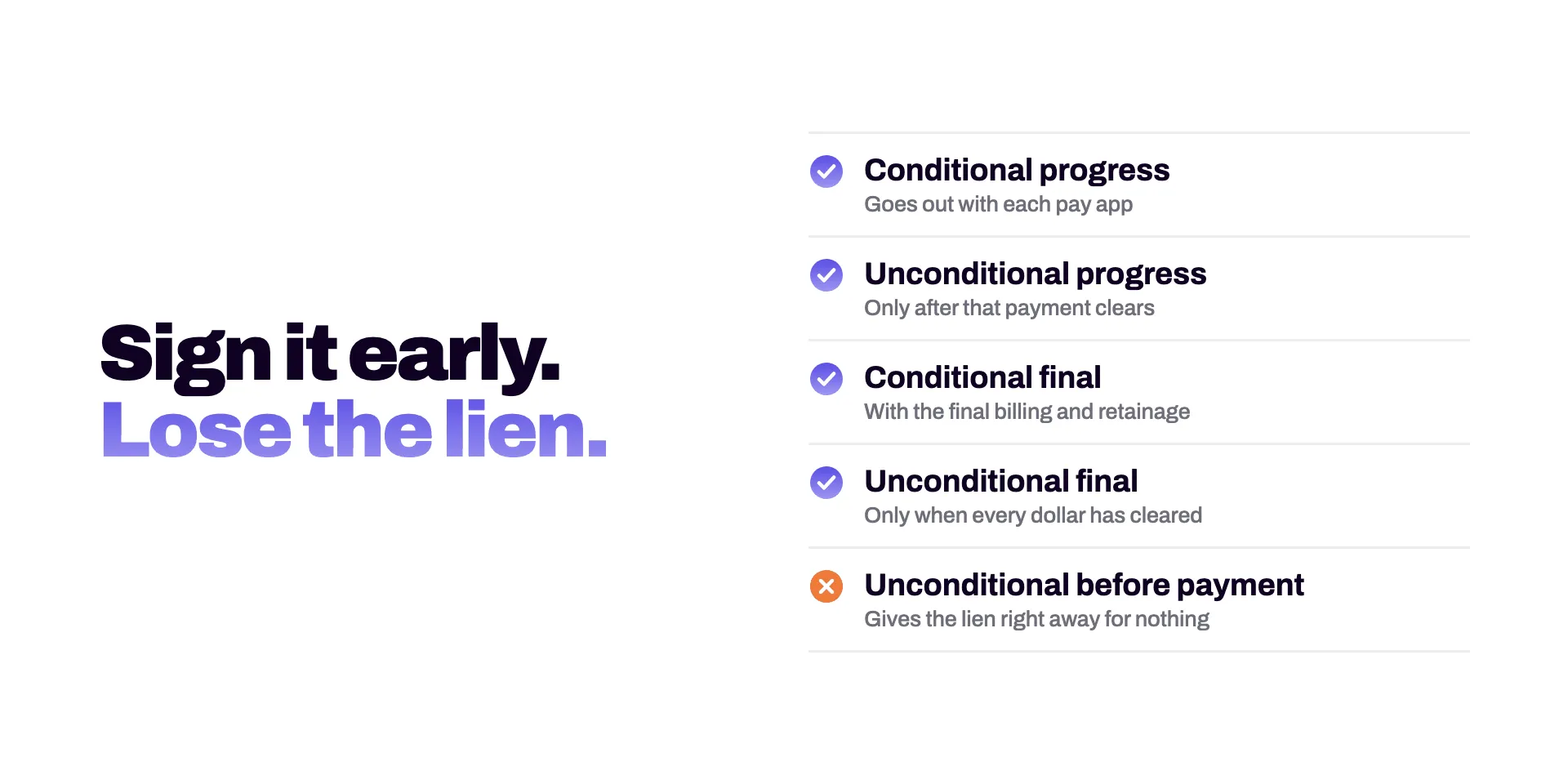
Procore Pay ties the payment to the waiver. Procore’s page says it collects and stores signed unconditional lien waivers that are only released after payment is complete, and routes each disbursement through an approval chain. On a retainage release, that means your final unconditional waiver sits in Procore until the GC’s payment goes. For waiver tools outside Procore, see best lien waiver management software.
What the sub still has to chase
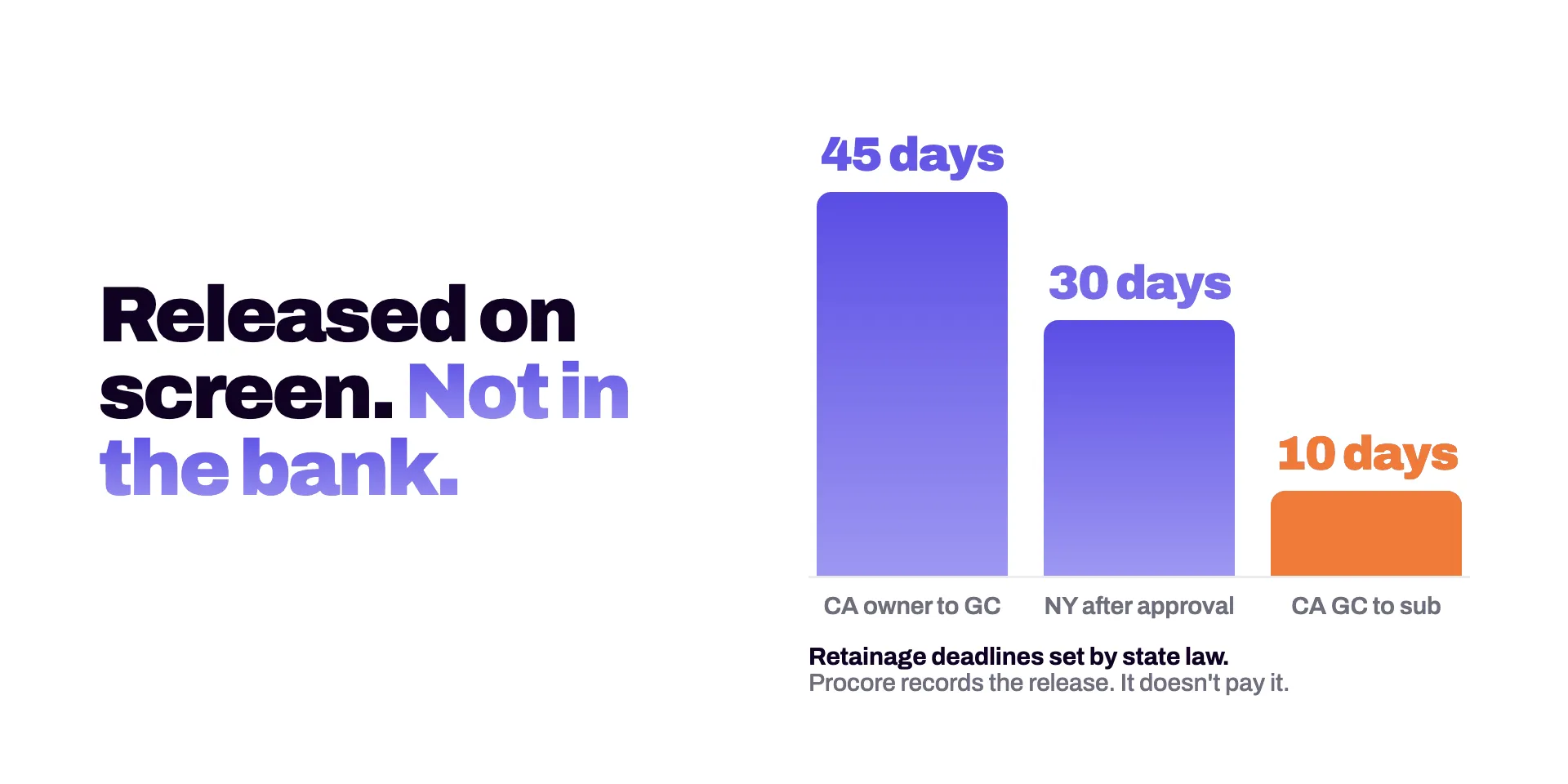
A release on screen is not cash in the bank. Five jobs stay with the subcontractor.
- Getting the release entered. Ask for it in an open billing period, usually with a release invoice and your close-out documents.
- The state deadline. Many states set when retainage must be paid after completion. California: the owner pays the direct contractor within 45 days of completion, and the direct contractor pays each sub’s share within 10 days of receiving it (Cal. Civ. Code §§8812, 8814). New York: within 30 days of final approval of the work (N.Y. Gen. Bus. Law §756-c). See California, New York and every other state on retainage laws by state.
- Matching the payment. The release often arrives in one deposit with a progress payment, or weeks later on its own. Someone has to tie it to the job and clear retainage receivable.
- Your own sub-tiers. Their retainage is now due on your clock. California gives you 10 days from receipt.
- Your books. The GC’s Procore project does not write to your QuickBooks. If you also run Procore, its QuickBooks connector sends owner invoices with retainage as a summarised line, and payments stay outside the sync.
Where Fynex sits
Fynex runs beside Procore and your ledger; it is not a project system. It takes the money jobs the release leaves behind.
| Job | Procore | Fynex beside it | Manual workaround |
|---|---|---|---|
| Retainage held | Total Retainage per line, per GC project | Receivable per GC and payable per sub-tier, on one job record | Spreadsheet per GC |
| Release | Entered on the invoice by the GC | Release due date tracked against the state rule | Calendar reminders |
| Waiver | Unconditional released after payment (Procore Pay) | Conditional before, unconditional after, for your sub-tiers | |
| Payment received | Outside your books | Deposit matched to the job, receivable cleared, posted to QuickBooks or Sage | Bank statement by hand |
| Your sub-tiers’ share | Not in the GC’s project | Released by rule, paid by ACH in one run | Bank portal, one at a time |
Customer funds are held by Fondy Ltd (FCA FRN 900705). More on the payable side: subcontractor payouts.
When Fynex is the wrong choice: if you have one GC, a few jobs a year and retainage you can track on a sticky note, you do not need it. If your GC pays your sub-tiers directly through Procore Pay, the payable side is already handled. Fynex earns its place when retainage sits across many GCs’ Procore projects and nobody can say, today, what is owed to you and by you.
Sources
All fetched 2026-10-13.
- Procore, Set or Release Retainage on a Subcontractor Invoice: https://v2.support.procore.com/product-manuals/invoicing-project/tutorials/set-or-release-retainage-on-a-subcontractor-invoice
- Procore, Create a Subcontractor Invoice for Release of Retainage: https://v2.support.procore.com/product-manuals/invoicing-project/tutorials/create-an-invoice-for-release-of-retainage
- Procore, Set and Release Retainage on an Owner Invoice: https://v2.support.procore.com/product-manuals/invoicing-project/tutorials/Set_and_Release_Retainage_on_an_Owner_Invoice
- Procore, What is sliding scale retention?: https://v2.support.procore.com/faq-what-is-sliding-scale-retention
- Procore, 360 Reporting data change log: https://v2.support.procore.com/product-manuals/reports-project/data-change-log
- Procore Pay: https://www.procore.com/pay
- State statutes as cited on each Fynex state page, with links to the official text.
Related: Procore and QuickBooks: what syncs · Best construction billing software for subcontractors · Retainage laws by state · Fynex for construction